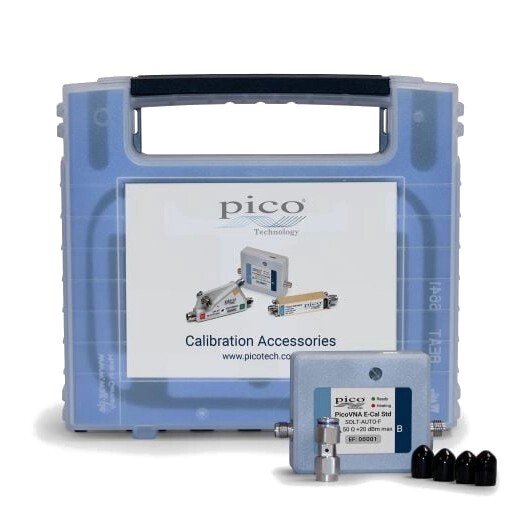
The PicoVNA E-Cal 8.5 GHz Automated Calibration Kit with SMA Female Ports, order code TA519, is designed to simplify two-port VNA calibration while reducing repeated connection and disconnection of individual mechanical standards.
The module combines:
- Two 50 Ω SMA female RF ports
- Short, open, load and through calibration states
- A separately characterised and polarised port adaptor
- Full multipath S-parameter characterisation
- Frequency coverage from 300 kHz to 8.5 GHz
- USB power and control
- Embedded calibration data
- Oven-controlled temperature stabilisation
- Automatic operation through PicoVNA software
- Protective carrying case
The TA519 is suitable for laboratories, production facilities, universities, RF development teams and automated test systems that regularly perform two-port vector network analyser calibration.
Automated Two-Port SOLT Calibration
SOLT calibration uses four standards:
A conventional manual calibration requires each standard to be connected separately during the calibration process.
This can involve:
- Repeated connector mating
- Manual standard selection
- Correct torque application
- Loading individual calibration files
- Repositioning test cables
- Repeating the process for each VNA port
Every additional connection can introduce:
- Connector wear
- Contamination
- Torque variation
- Cable movement
- Incorrect standard selection
- Operator error
- Measurement repeatability problems
The TA519 reduces the manual process to one RF connection. PicoVNA software then automatically switches between the module’s internal calibration states and reads its stored characterisation data through USB.
SMA Female Port Configuration
The TA519 provides:
- Two SMA female RF ports
- 50 Ω nominal impedance
- Two-port calibration capability
- Female calibration reference planes
The female configuration is suitable where the VNA test setup terminates in SMA male connectors.
Typical compatible configurations include:
- SMA male test cables
- Male connectorised fixtures
- Male-to-male cable assemblies
- Male-ended VNA test leads
- Devices requiring female calibration reference planes
- PCB fixtures fitted with SMA male launches
- RF adaptors and connector assemblies
The TA519 should not be described as having both male and female ports. Both RF calibration ports are SMA female.
For SMA male calibration ports, the corresponding Pico model is the TA518 SOLT-AUTO-M.
300 kHz to 8.5 GHz Frequency Range
The TA519 is fully characterised from:
This range supports VNA calibration for applications involving:
- RF filters
- Amplifiers
- Antennas
- Cables
- Connectors
- Attenuators
- Couplers
- Splitters
- Wireless modules
- PCB transmission lines
- Matching networks
- Cellular systems
- Wi-Fi and Bluetooth
- GNSS
- RFID and IoT equipment
- Sub-GHz communication products
The page should use the full specification of 300 kHz to 8.5 GHz, rather than only stating 8.5 GHz.
Internal Calibration Standards
The TA519 electronically switches between internally incorporated:
- Short standard
- Open standard
- Load standard
- Through standard
These states allow PicoVNA software to calculate correction terms for systematic measurement errors.
A two-port SOLT calibration can correct for:
- Directivity
- Source match
- Load match
- Reflection tracking
- Transmission tracking
- Forward measurement errors
- Reverse measurement errors
- Isolation and crosstalk, depending on the selected calibration procedure
Once calibration is completed, the measurement reference planes are established at the selected test-port or cable endpoints.
Full S-Parameter Characterisation
Electronic calibration standards are not perfectly ideal.
Internal RF switches, connectors and transmission paths introduce small differences between the actual module response and a theoretical open, short, load or through.
Pico Technology addresses this by supplying:
- Full-span multipath S-parameter characterisation
- Data covering 300 kHz to 8.5 GHz
- Individually embedded module data
- Automatic data reading through USB
- Traceable characterisation
PicoVNA software uses the actual characterised response of the module during calibration rather than assuming mathematically ideal standards.
Embedded Calibration Data
The module stores its characterisation records internally.
When connected through USB, PicoVNA software can:
- Identify the E-Cal module
- Read its calibration data
- Load the required standard definitions
- Control internal switching
- Apply the characterisation during calibration
- Store the completed VNA calibration
This eliminates the need to manually locate and load separate standard definition files for every calibration operation.
Oven-Controlled Temperature Stabilisation
The TA519 includes a fast-response internal oven that stabilises the calibration standards.
Published environmental performance includes:
- Oven control range of 18°C to 28°C
- Typical warm-up time of 45 seconds at 23°C
- General operating temperature from 5°C to 40°C
Temperature stabilisation helps reduce changes in the electrical response of the module caused by ambient temperature variation.
This supports:
- Better calibration repeatability
- More consistent S-parameter measurements
- Reduced temperature-related drift
- Reliable production testing
- More stable repeated calibrations
The module should be allowed to complete its warm-up period before calibration begins.
USB Power, Control and Data Transfer
The TA519 uses a USB 2.0 Micro interface for:
- Electrical power
- E-Cal module identification
- Internal standard switching
- Characterisation-data transfer
- Communication with PicoVNA software
A separate power adaptor is not required for the E-Cal module.
The USB connection controls the calibration module but does not carry the RF measurement signal. RF calibration takes place through the two SMA female ports.
Calibration Performance
The TA519 provides published residual calibration performance of:
- Directivity: 40 dB
- Source match: 40 dB
- Load match: 36 dB
- Reflection tracking: 0.05 dB
- Transmission tracking: 0.04 dB
These figures describe the calibration performance associated with the characterised module under the specified operating conditions.
Final VNA measurement accuracy also depends on:
- Vector network analyser model
- Test cable quality
- Connector condition
- Correct connector torque
- Measurement bandwidth
- Frequency span
- Source power
- Cable movement
- Device mismatch
- Environmental stability
- Calibration reference-plane positioning
Port Power Limits
The TA519 RF ports have the following published limits:
- Maximum normal operating input: +10 dBm
- Protection limit: +20 dBm or 1 V peak
The protection limit should not be treated as a normal operating level.
Before calibration, the VNA test-port power should be checked to ensure it remains within the module’s specified operating range.
Traceable Characterisation
Pico Technology states that its VNA calibration and check standards are calibrated against fully traceable PC3.5 standards.
Traceability is valuable for:
- RF research laboratories
- Product development
- Production testing
- Quality assurance
- Measurement verification
- Calibration-controlled environments
- University laboratories
- Telecom component testing
- Automated RF validation
- Internal measurement assurance programmes
The product page should describe the module as having traceable characterisation data.
An NABL calibration certificate should only be mentioned when RevineTech has separately confirmed that one is included in its commercial package.
One-Connection Calibration Process
A typical TA519 calibration workflow includes:
- Allow the VNA, cables and E-Cal module to stabilise.
- Inspect and clean all SMA connectors.
- Connect the TA519 to the two SMA male test-port reference planes.
- Apply the recommended connector torque.
- Connect the module to the computer through USB.
- Select automated E-Cal in PicoVNA software.
- Allow the software to identify the TA519.
- Wait for the oven warm-up process to complete.
- Start the automated SOLT calibration.
- Allow the module to switch between its internal standards.
- Save the completed calibration.
- Disconnect the E-Cal module.
- Connect the device under test without disturbing the test cables.
Automated switching reduces manual operations, but correct connector handling and cable positioning remain important.
Reduced Connector Wear
Traditional mechanical calibration may require several standards to be connected and disconnected during each calibration.
Automated E-Cal can reduce:
- RF connector mating cycles
- Connector wear
- Manual handling
- Calibration time
- Incorrect standard selection
- Torque inconsistency
- Cable movement
- Operator-dependent variation
This is particularly useful in production facilities and laboratories where calibration is repeated frequently.
Improved Calibration Repeatability
The TA519 helps improve repeatability by combining:
- Internally switched standards
- Embedded characterisation data
- Temperature stabilisation
- Software-controlled operation
- Reduced manual connections
- Consistent standard sequencing
More frequent and repeatable calibration can help maintain measurement confidence when fixtures, cables or environmental conditions change.
Suitable for Automated Test Systems
The TA519 is suitable for automated and semi-automated RF measurement environments.
Applications include:
- Production-line calibration
- Automated device characterisation
- Repeated component screening
- Remote laboratory measurements
- Multi-operator test stations
- Research automation
- RF fixture validation
- Measurement-system maintenance
The calibration module can be incorporated into a controlled test procedure using PicoVNA software and compatible automation workflows.
Compatible PicoVNA Systems
The 300 kHz to 8.5 GHz frequency coverage supports calibration of current PicoVNA instruments operating within this range.
Typical use includes:
- PicoVNA 106
- PicoVNA 108
- Compatible PicoVNA test setups using SMA male reference planes
The selected VNA sweep must remain within the characterised bandwidth of the E-Cal module.
TA519 Versus TA518
| Feature |
TA519 |
TA518 |
| Product type |
Automated E-Cal module |
Automated E-Cal module |
| RF ports |
Two SMA female |
Two SMA male |
| Frequency range |
300 kHz to 8.5 GHz |
300 kHz to 8.5 GHz |
| Calibration method |
Two-port SOLT |
Two-port SOLT |
| Power and control |
USB |
USB |
| Temperature control |
Internal oven |
Internal oven |
| Typical use |
Male test-cable ends |
Female test-cable ends |
Users requiring both connector genders can consider the TA520 Dual E-Cal Kit, which contains TA518 and TA519 modules.
Applications
The PicoVNA TA519 is suitable for:
- Two-port VNA calibration
- Antenna measurement
- RF filter testing
- Amplifier characterisation
- Cable and connector analysis
- PCB transmission-line testing
- Wireless module development
- RF component evaluation
- Cellular product testing
- Wi-Fi and Bluetooth development
- GNSS component measurement
- Production RF testing
- Automated test equipment
- Research laboratories
- University RF laboratories
- Measurement verification
- Calibration-controlled workflows